
From Factory Acceptance to Final Delivery: A Practical Guide to Industrial Inspection Types
Industrial equipment can pass a factory test and still arrive damaged, incomplete or improperly documented. A risk-based inspection plan therefore follows the product throughout its lifecycle—from manufacturing and FAT through pre-shipment inspection, packing, loading, transit, unloading and final receipt.
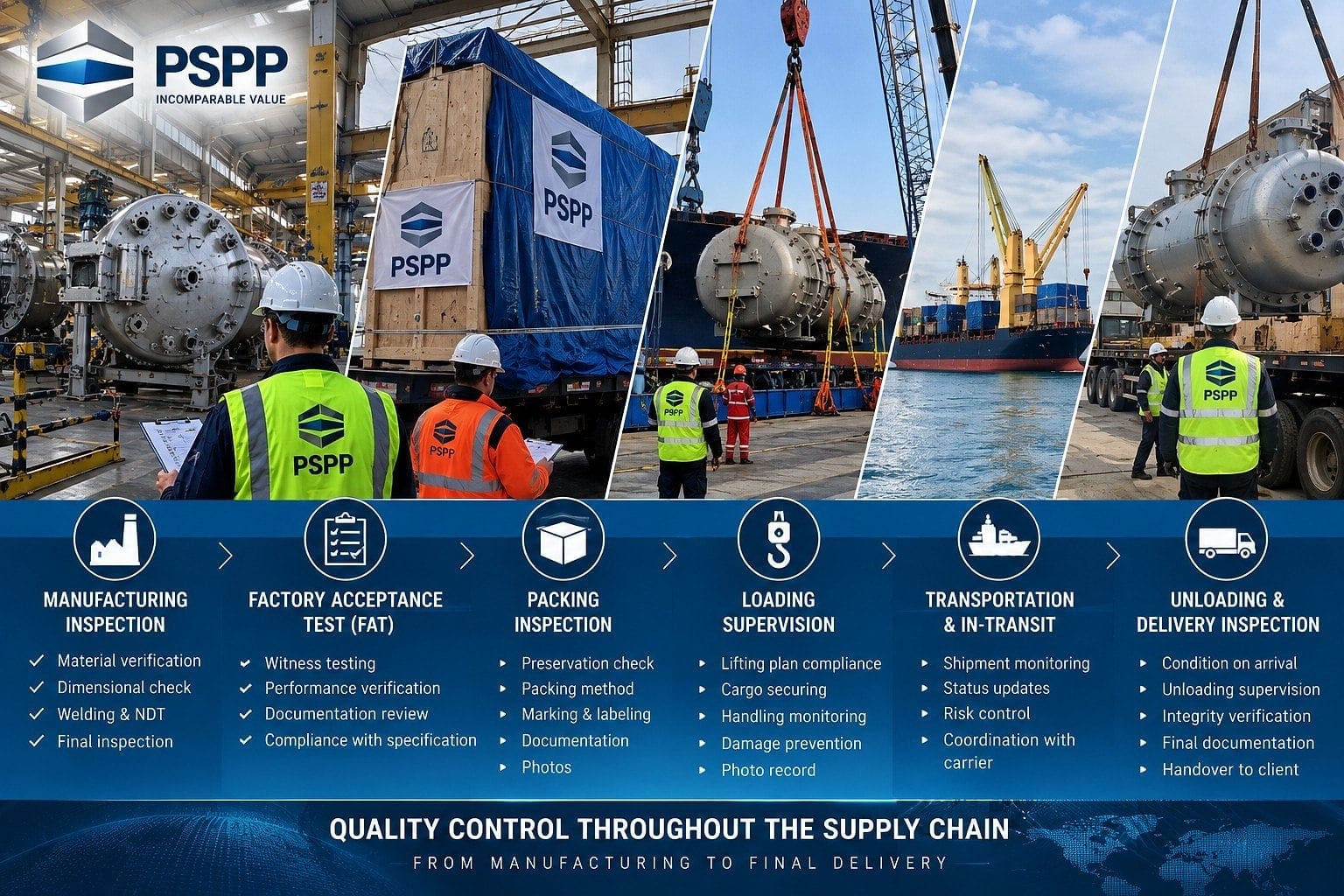
Industrial equipment can pass a factory test and still arrive damaged, incomplete or improperly documented. A risk-based inspection plan therefore follows the product throughout its lifecycle—from manufacturing and FAT through pre-shipment inspection, packing, loading, transit, unloading and final receipt.
Executive summary
Inspection in industrial supply chains is not a single event. It is a sequence of complementary controls designed to answer different questions: Does the equipment meet technical specifications? Is it ready for dispatch? Is it adequately protected? Is the cargo correctly secured? Did it arrive in acceptable condition? This article explains the main inspection and witnessing activities, their typical timing, evidence and limitations, and how they can be integrated into an Inspection and Test Plan (ITP). References to international standards and industry guidance are provided in numbered form [1–10].
1. Why the inspection stage matters
Industrial procurement commonly involves manufacturers, subcontractors, freight forwarders, carriers, warehouse operators, site contractors and end users. Each handover introduces potential quality and logistics risks. A technically conforming item may be damaged by moisture, mishandling, vibration or inadequate cargo securing; conversely, an undamaged shipment may still fail contractual technical requirements. The inspection strategy should therefore reflect product criticality, contractual obligations, transport route, handling methods and consequences of failure [1–3].
There is no universal, fixed number of inspection types. The categories below are practical service descriptions rather than a single internationally standardized classification. Several may be combined in one assignment, and their exact scope must be specified in the purchase order, ITP, inspection instruction or contract.
2. Inspection and witnessing during manufacture
2.1 Incoming material and component inspection
Performed when raw materials, bought-out components or subcontracted items are received by the manufacturer. Checks may include identification, quantity, material test certificates, traceability, visible condition and specified dimensional or technical requirements. It helps prevent nonconforming inputs from entering production [1,2].
2.2 In-process inspection and manufacturing surveillance
Conducted at defined production stages such as fabrication, welding, assembly, coating, machining or electrical installation. Surveillance may include review of manufacturing records, witnessing of specified tests, verification of personnel qualifications and observation of process controls. Hold and witness points should be defined in the ITP; an inspector should not claim to have witnessed a step that occurred before attendance [1,2].
2.3 Factory Acceptance Test (FAT) witnessing
FAT is a planned demonstration, normally at the manufacturer’s facility, that specified equipment functions or performance criteria have been met before dispatch. Examples include functional sequences, alarms and interlocks, electrical checks, pressure or leak tests where specified, and verification of contractual documentation. FAT is not equivalent to a comprehensive design validation, and its scope must follow the approved test procedure and agreed acceptance criteria. Deficiencies, open punch items and retest requirements should be recorded [1,2].
2.4 Final inspection at the manufacturer
A final product inspection verifies agreed characteristics after manufacture, potentially including dimensions, configuration, workmanship, nameplates, markings, accessories, documentation and outstanding punch items. A completed FAT does not automatically replace final inspection: one establishes demonstrated test performance; the other may confirm physical completeness and shipment readiness.
3. Inspection before shipment
3.1 Pre-Shipment Inspection (PSI)
PSI is typically carried out when goods are substantially complete and ready for dispatch. The inspection scope can cover identity, quantity, visible condition, workmanship, conformity to purchase-order requirements, labeling, accessories, packaging and documentation. Sampling may be used only when contractually authorized and technically suitable; ISO 2859-1 provides acceptance-sampling procedures for specified applications but does not make sampling appropriate for every industrial item [4].
3.2 Packing and preservation inspection
Examines whether equipment is protected against anticipated handling, storage and transport conditions. Checks may cover crates, skids, bracing, corrosion inhibitors, desiccants, moisture barriers, seals, lifting points, preservation records, spare parts and packing lists. Special attention is required for long-duration storage, marine shipment, sensitive electronics and machined surfaces. Handling symbols may be assessed against applicable ISO 780 conventions [5].
3.3 Marking, identification and documentation verification
Confirms that item tags, serial numbers, shipping marks, package counts, weights and dimensions correspond to the applicable documents. This reduces the risk of misdelivery, handling errors and loss of traceability. The applicable marking scheme may derive from the contract, customer specification or transport requirements; container identification can be checked against ISO 6346 where relevant [6].
4. Warehouse and storage inspections
Warehouse inspection assesses the condition and management of goods during interim storage. It may include stock identification, quantity reconciliation, preservation status, segregation of damaged or nonconforming items, humidity and environmental controls, stacking, access and handling conditions. Reinspection may be appropriate after prolonged storage or when packaging has been opened. An inspection snapshot does not establish that storage conditions remained compliant throughout an unattended period.
5. Container and transport-unit inspections
5.1 Container condition inspection
Before stuffing, an inspector may check a freight container or cargo transport unit for visible structural damage, floor condition, door operation, cleanliness, water ingress evidence and suitability for the cargo. The CTU Code provides internationally recognized good-practice guidance for packing cargo transport units [7]. Container suitability must also account for the actual cargo and transport mode.
5.2 Loading supervision
Loading supervision verifies that the correct cargo is loaded in the agreed quantity and condition, using suitable handling arrangements. Typical evidence includes package identification, pre-loading photographs, loading sequence, observed handling, final count and seal information where applicable. It should be clear whether the inspector witnessed the entire loading operation or only selected stages.
5.3 Lashing, stowage and securing inspection
This focuses on restraint and distribution of cargo within a container, truck, trailer or other transport unit. Checks may address blocking, bracing, tie-down arrangements, load distribution, contact protection and the cargo-securing plan. The CTU Code provides relevant guidance; however, securing design and adequacy must be determined for the specific load and transport conditions by competent parties [7].
5.4 Container sealing and dispatch verification
May include recording the container number, seal number, dispatch condition and accompanying documents. A seal number is evidence of identification at a point in time; it does not independently prove that a shipment was never opened or altered thereafter.
6. Inspections during transportation and at destination
6.1 Transit or cargo-condition inspection
Performed at an intermediate handover, transfer terminal or other accessible checkpoint to document cargo condition and any visible evidence of movement, moisture, impact or package damage. The inspection scope is limited to accessible items and conditions at the time of attendance.
6.2 Unloading supervision
Verifies cargo identity, package count, apparent condition and handling practices during discharge. Photographic records of damage observed before, during and after unloading help establish the condition at the handover; they do not automatically establish causation or liability.
6.3 Quantity and condition survey
Records delivered quantities and observable condition against packing lists, delivery notes or other agreed records. Where discrepancies exist, the survey should distinguish verified facts from allegations or conclusions that require additional investigation.
6.4 Damage survey and investigation support
When damage is suspected, a survey may document the location, nature and extent of visible damage, packaging condition, relevant shipment records and potential preservation failures. Cause attribution may require specialized engineering, laboratory work or further evidence. Survey findings should avoid unsupported conclusions about fault or insurance coverage.
6.5 Final delivery / receiving inspection
Confirms that the receiving organization has obtained the specified items and documentation in the recorded condition. It can include verification of identification, quantity, completeness, preservation status, visible damage and outstanding discrepancies. Site Acceptance Testing (SAT), when required, is a separate functional or performance activity conducted after installation or at the destination; it should not be confused with simple goods receipt.
7. Inspection stages at a glance
ProductionIncoming / in-process surveillance: Was the item produced under specified controls?
Pre-dispatchFAT / final inspection: Does it meet agreed technical and functional criteria?
Shipment readinessPSI / packing / preservation: Is the correct item complete and protected?
StorageWarehouse inspection: Has the condition been maintained?
LoadingContainer / loading / lashing: Was the cargo correctly loaded and secured?
TransitCondition survey: Is there evidence of deterioration or damage?
DestinationUnloading / receipt / damage survey: What was delivered and in what condition?
After installationSAT (if specified): Does the installed system meet site test requirements?
8. FAT, PSI and loading inspection: the essential distinction
These three activities are frequently grouped together in procurement discussions, but they answer different questions. FAT evaluates specified equipment performance or functions under a defined test procedure. PSI verifies the goods and shipment readiness against an agreed scope before dispatch. Loading inspection documents the identity, condition, handling and securing of cargo during loading. None automatically substitutes for the others. A pump can pass FAT but be shipped with the wrong spare parts; a correct shipment can be damaged through inadequate lashing; and intact delivery packaging cannot prove the pump passed FAT.
9. How to select the appropriate inspection scope
Inspection planning should begin with a risk assessment and the purchase-order or project requirements. Important considerations include product criticality, manufacturing complexity, supplier history, value, lead time, potential safety consequences, fragility, preservation needs, route and mode of transport, and the cost of replacement or delay. The ITP should identify activities, responsibilities, applicable documents, acceptance criteria, hold/witness points, notification periods and reporting requirements [1,2].
The use of sampling, remote inspection or photographic evidence must be justified by the task and agreed with the client. Critical hold points or performance demonstrations may require physical witnessing. ISO/IEC 17020 provides requirements relevant to the competence and impartiality of inspection bodies, while ISO 19011 gives guidance on auditing management systems; neither should be misrepresented as a universal checklist for cargo inspections [3,8].
10. Reporting, traceability and nonconformity management
A useful inspection report identifies the inspected item, location, date, inspector, scope, referenced documents, actual observations, evidence, limitations and outcome against the specified criteria. Nonconformities should be recorded objectively with references to the relevant requirement and supporting evidence. If access is limited or a test is not witnessed, the report must say so. A release note, inspection report or shipment clearance should not be interpreted as a warranty of hidden condition or future performance.
Where findings remain open, the report should distinguish between accepted deviations, outstanding punch items, corrective actions and items requiring client disposition. Photo records and package identifiers should be organized to support traceability across handovers.
11. 3BPSPP d.o.o.’s role in independent industrial inspection
3BPSPP d.o.o. supports manufacturers, procurement teams, EPC contractors and asset owners by coordinating qualified independent inspectors, expeditors and auditors for industrial assignments across Europe, Asia and other markets. Services may include vendor inspection, manufacturing surveillance, FAT witnessing, PSI, packing and preservation checks, warehouse and loading supervision, cargo-condition surveys, expediting and technical documentation review. The specific scope and competence requirements are agreed for each assignment.
Our focus is evidence-based reporting, professional impartiality and timely communication of findings so that clients can make informed decisions before manufacturing milestones, shipment release and receipt of goods.
12. Conclusion
The most effective industrial inspection strategy follows the asset from manufacture to delivery, rather than relying on a single final checkpoint. FAT, PSI, packing inspection, loading supervision, transport-condition surveys and receiving inspection address different risks and provide different evidence. When coordinated through a clear ITP and documented handover controls, these activities improve visibility, reduce avoidable surprises and support informed quality decisions.
Key principle
Inspect the right characteristic, at the right stage, against the right requirement—and record only what was actually verified.
References
[1] ISO. ISO 9001:2015, Quality management systems — Requirements. International Organization for Standardization. https://www.iso.org/standard/62085.html
[2] ISO. ISO 10005:2018, Quality management — Guidelines for quality plans. International Organization for Standardization. https://www.iso.org/standard/70398.html
[3] ISO/IEC. ISO/IEC 17020:2012, Conformity assessment — Requirements for the operation of various types of bodies performing inspection. International Organization for Standardization. https://www.iso.org/standard/52994.html
[4] ISO. ISO 2859-1:1999, Sampling procedures for inspection by attributes — Part 1: Sampling schemes indexed by acceptance quality limit (AQL) for lot-by-lot inspection. International Organization for Standardization. https://www.iso.org/standard/1141.html
[5] ISO. ISO 780:2015, Packaging — Distribution packaging — Graphical symbols for handling and storage of packages. International Organization for Standardization. https://www.iso.org/standard/59933.html
[6] ISO. ISO 6346:2022, Freight containers — Coding, identification and marking. International Organization for Standardization. https://www.iso.org/
[7] IMO, ILO and UNECE. (2014). Code of Practice for Packing of Cargo Transport Units (CTU Code). International Maritime Organization. https://www.imo.org/en/OurWork/Safety/Pages/CTU-Code.aspx
[8] ISO. ISO 19011:2018, Guidelines for auditing management systems. International Organization for Standardization. https://www.iso.org/standard/70017.html
[9] International Chamber of Commerce. (2019). Incoterms® 2020. ICC Publishing. https://iccwbo.org/business-solutions/incoterms-rules/incoterms-2020/
[10] IMO. International Convention for the Safety of Life at Sea (SOLAS), Chapter VI: verified gross mass requirements for packed containers. International Maritime Organization. https://www.imo.org/en/OurWork/Safety/Pages/Verification-of-the-gross-mass.aspx